
Diploma in Interior Architecture & Design (T22)


Course Overview
As urban lifestyles evolve and spatial constraints grow, the role of designers has never been more critical. From inter-generational living to hybrid home-office setups, you will learn to design spaces that respond thoughtfully to emerging needs, social trends, and cultural contexts.
This diploma draws on interior and architectural perspectives, training you to think beyond aesthetics. You will learn to reimagine spatial experiences through adaptive, immersive, human-centred design. Whether crafting sensory environments or tackling complex constraints, you'll build a strong conceptual and technical foundation to shape meaningful spaces that evolve with people's lives. You will also explore how sustainability, lifestyle, and social change shape the built environment, and engage with real-world challenges through industry projects, mentorships, and internships. With accreditation from the Board of Architects Singapore, this course prepares you for a smooth transition into university-level architecture studies.
Throughout your journey, you will sharpen your design sensibility through rigorous studio work, study trips, and industry exposure. You will graduate with the ability to design for diverse sectors—from hospitality and retail to property and experience design—ready to shape the spaces of tomorrow with purpose and imagination.

BEST OF BOTH WORLDS
Can’t decide between Interior Design and Architecture? This is the only course in a polytechnic that covers both interior design and architectural design.

DISCOVER LIGHT
Play with lights! Learn the importance of good lighting in interior design as you experiment with different lighting styles in the Lighting Lab. A first in a polytechnic, this is a unique lab dedicated to lighting design.

STUDY WAIVER
Recognised by the Board of Architects Singapore, you can get up to two years of university study waived when they enrol in an architecture degree programme.


Entry Requirements
To be eligible for consideration for admission, applicants must obtain 26 points or better for the net ELR2B2 aggregate score (i.e. English Language, 2 relevant subjects and best 2 other subjects, including CCA Bonus Points) and meet the minimum entry requirements of this course. CCA cannot be used to meet the minimum entry requirements.
Subject
Grade
English Language
1-7
Mathematics (E or A)
1-7
Any one of the subject in the 2nd group of relevant subjects for ELR2B2-D Aggregate Type
- Art
- Biology
- Biotechnology
- Chemistry
- Computing / Computer Studies
- Creative 3D Animation
- Design & Technology
- Design Studies
- Food & Nutrition/ Nutrition & Food Science
- Electronics / Fundamentals of Electronics
- Higher Art
- Media Studies (English)
- Media Studies (Chinese)
- Physics
- Science (Chemistry, Biology)
- Science (Physics, Biology)
- Science (Physics, Chemistry)
1-6
2026 Planned Intake
55
Net ELR2B2 aggregate range (2026 JAE)
4 - 12
• Singapore-Cambridge GCE O Level applicants with good grades in the relevant subjects at their Singapore-Cambridge A Level may be granted subject exemption on a subject by subject basis.
• Applicants who are in the Singapore Integrated Programme are considered for admissions based on their Year 4 school results, pegged closely to the course entry requirements for Singapore-Cambridge GCE O Level qualification.
Note:
- Applicants with mild or severe colour vision deficiency may have difficulties meeting the course requirements and expectations. Interested applicants with mild or severe colour vision deficiency are highly encouraged to contact Temasek Polytechnic for more information.
- Applicants with severe visual impairment may have difficulties meeting the course requirements and expectations. Interested applicants with severe visual impairment are highly encouraged to contact Temasek Polytechnic for more information.
- Applicants with physical impairment or are physically dependent on mobility equipment may have difficulties meeting the course requirements and expectations. Applicants with impaired or limited motor functions may be assessed on a case-by-case basis to determine their suitability for the course. Interested applicants with physical impairment are highly encouraged to contact Temasek Polytechnic for more information.
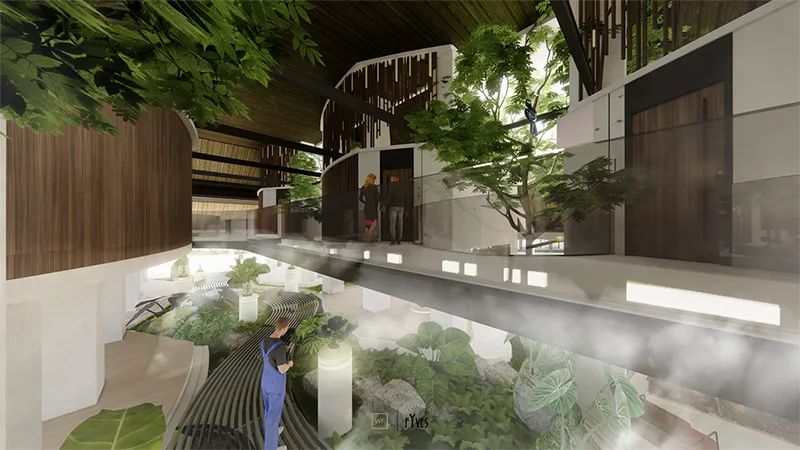
Fyves
A forest resort rich in nature, allowing people to experience a numerous variety activities and establishments during vacation while benefiting businesses around. A space for people to retreat and immerse themselves to improve their well-being through Ecotherapy, the resort creates a space for wildlife, ensuring long-term population persistence and conservation.
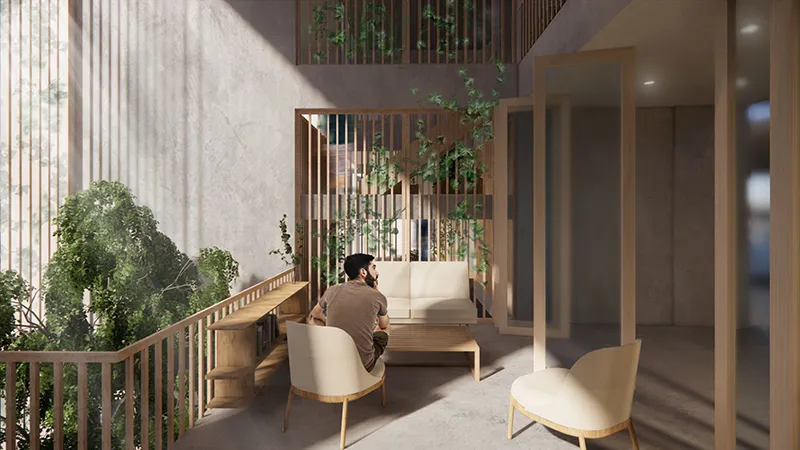
Sustenance
From the COVID-19 pandemic, we discovered the lack of proper pandemic infrastructure within our local communities. Sustenance is a community isolation facility that provides temporary accommodation for infected patients with mild symptoms awaiting discharge, while also maintaining longevity and providing Sustenance to both the infrastructure and its users.
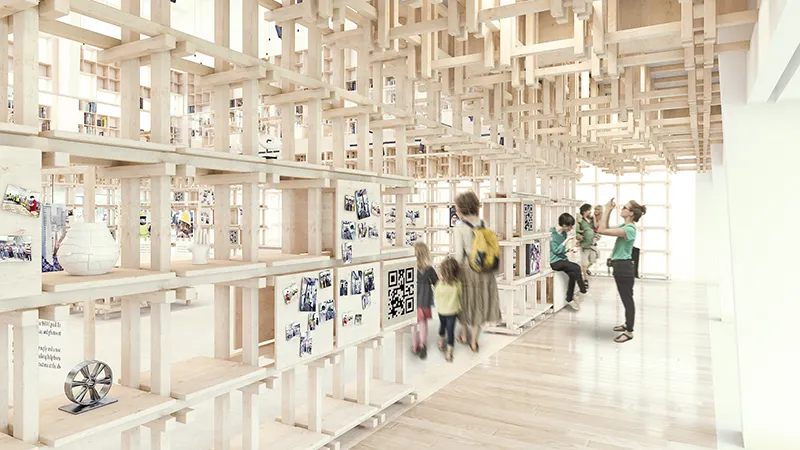
PADI
PADI is a space for migrant workers to interact freely with their friends, providing them opportunities to engage with the public. In doing so, the space aims to help them improve their mental wellbeing and provide them with a sense of belonging in Singapore.
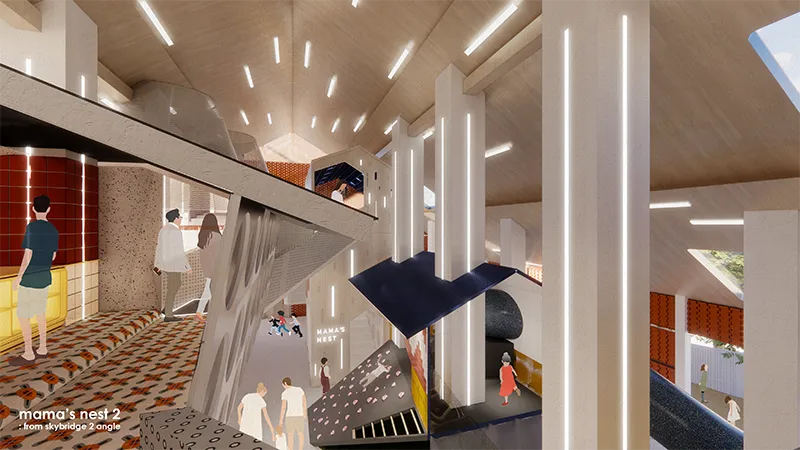
HOLI’s Enclave
Due to the isolation during the COVID-19 lockdown, developmental delays are more common in young children compared to the last five years. HOLI'S Enclave is a developmental growth and workspace centre for children facing developmental delays. An unbound space where children can play, learn and socialise while destigmatising developmental disabilities.
- Year 1
- Year 2
- Year 3
- TPFun
You will take this set of subjects that builds your foundation skills, strengthens your craft, and encourages you to experiment and discover with confidence.
| Subject Code | Subject | Credit Units | ||
|---|---|---|---|---|
| DIA1240 | Architectural Drawing
This subject covers the fundamental knowledge and skills to construct basic architectural drawings, orthographic projections and perspective views to communicate spatial design ideas professionally. |
4 | ||
| DCF1051 | Ideas & Concepts
This subject introduces foundational approaches to inquiry, observation, ideation, and critical thinking within a design context. Real-world issues are uncovered through fieldwork and informal interviews, enabling the discovery of human needs and the framing of designable challenges. Creative thinking is approached as an iterative process, with ideas refined through feedback and experimentation. The design process is emphasised as a means of navigating ambiguity, extracting meaning from complexity, and translating insights into clear visual concepts and proposals. |
2 | ||
| DCF1052 | Narratives in Design
This subject introduces storytelling as a strategic tool within design practice. It covers key narrative principles and structures to visualise and communicate ideas. The emphasis is on applying narrative techniques to enhance meaning, clarity, memorability and emotional engagement in design outcomes. Foundational storytelling skills that support concept development and strengthen the overall creative process are also addressed. |
2 | ||
| DCF1053 | Aesthetic & Design Sensibility
The subject introduces the visual language of design, emphasising both its aesthetic and communicative functions. It covers the elements of visual art and the principles of design to build on the understanding of two-dimensional (2D) and three-dimensional (3D) forms. It will involve foundational skills in material manipulation and form-making to support creative expression |
4 | ||
| DCF1054 | Design Software Essentials
This subject covers essential, industry-standard design software widely used across creative disciplines. It will introduce foundational digital skills and fluency in applying software tools to industry-relevant workflows, building competence for further design practice and applied projects. |
2 | ||
| DCF1055 | Foundation Studio
This subject develops fundamental discipline-specific skills within the design process and introduces contextual studies as a framework for integrating historical, cultural and social considerations into contemporary design practice. It examines how contextual factors inform design thinking and creative decision-making. |
6 | ||
| DIA1244 | Design Studio: Idea-Driven
This subject introduces idea driven interior architectural design through a simple and structured design process that allows for innovation of a given space. Working with a given space and empathetic persona studies, the subject focuses on generating a clear central design idea that responds to users, site and context. The subject covers observational and analytical approaches to spatial design development, including spatial concepts, design strategies, spatial diagramming, layout planning, and basic volumetric studies. It covers the initiation, conceptualization, development and delivery of spatial proposals that address form, surface, volume, and spatial conditions in relation to persona, site, and context. |
6 | ||
| DIA1242 | Digital Visualisation
The subject covers the fundamental application of computer-aided design (CAD) software that is relevant to the context of built-environment, specifically focusing on interior and architectural projects in Singapore. |
2 | ||
| DIA2244 | Sustainable Space Planning
This subject focuses on spatial planning through the lens of sustainability to respond to the growing significance of design for human experience towards a sustainable future. It will cover the design of effective occupant experiences through the application of ergonomics, anthropometry, human behaviour, universal design and design programming. |
4 | ||
| DIA1245 | Spatial Elements: Sensory & Ambience
This subject covers the sensing and reading of space as a lived, felt experience, where every tangible and intangible quality contributes to create three-dimensional (3D) atmosphere. It introduces how the human body perceives spatial elements such as detail, texture, and sound. This includes the curation and sequencing of these elements to craft narratives that evoke a distinct sense of place. |
2 |

You will take this set of subjects that develops your ability to shape concepts, create solutions, and work across interdisciplinary contexts.
| Subject Code | Subject | Credit Units | ||
|---|---|---|---|---|
| DIA2257 | Digital Modelling
The subject covers the fundamentals of digital visualisation and presentation software, specific to the context of the spatial environment to support design communication |
4 | ||
| DIA3237 | Digital Integration
The subject covers the fundamentals of digital Building Information Modelling (BIM) and architectural visualisation (Arch Viz) software, specific to the context of architecture and interior design projects. The subject also covers the integrated workflow from modelling to visualisation that is commonly used in these projects. |
4 | ||
| DIA2252 | Design Studio: Site-Driven
This subject introduces a contextual design framework with a primary focus on site-driven exploration, including users, programme and context, as a foundation for the design process of spatial environments. It involves the evaluation of a site to identify environmental, programmatic, and developmental constraints and opportunities. Through detailed site investigation and analysis, key findings are interpreted to inform the development of spatial design proposals. The subject will have an emphasis on the exploration and refinement of form and space in relation to the site, user needs, and programme requirements, fostering critical inquiry, observation, and design reasoning grounded in site-specific understanding. |
6 | ||
| DIA2253 | Spatial Elements: Light & Materiality
The subject focuses on how lighting and materials shape the experience of a space. It looks at how different lighting elements and the choice of materials—both traditional and emerging—impact the look, feel, function, and emotional qualities of a spatial environment. The subject explores how these elements influence spatial experience, create a sense of identity, and respond to the unique characteristics of a space. |
4 | ||
| DIA2254 | Construction & Detailing: Architecture
The subject provides a foundational understanding of architectural structure and basic building materials, focusing on how they influence the design and function of three-dimensional spaces. It introduces key structural concepts and explores the role of materials and construction techniques in shaping the aesthetics and functionality of spaces, emphasising their impact on overall spatial design. |
2 | ||
| DIA3243 | Design Studio: Issue-Driven
This subject introduces a contextual design framework with a focus on identifying design issues and interpreting current trends as a foundation for spatial design. It emphasises the evaluation of a site and its users to identify environmental, social, economic, and programmatic constraints and opportunities. Through research and site investigations, data is analysed to inform the development of design proposals. The subject highlights how design issues emerge from a holistic understanding of site and its users, and how spatial design can respond to societal issues through contemporary trends and sustainable practices. It also incorporates industry-driven practice, engaging with briefs that emulate professional scenarios and developing design solutions responsive to context, user needs, and sustainability. |
6 | ||
| DIA2255 | Interior Systems & Services
This subject covers the relationship between interior design and building services systems, such as electrical, plumbing, and ventilation systems. It also focuses on how they inform spatial design, planning, and functionality within interior environments. |
2 | ||
| DIA2256 | Construction & Detailing : Interior
This subject focuses on the construction, detailing, and material articulation of interior spaces. It examines the integration of design detailing, finishes, and joinery, emphasising how thoughtful detailing enhances design quality, functionality, and user experience. The subject also covers technical and design proficiency in translating conceptual ideas into well-resolved interior environments that demonstrate constructability and design intent. |
4 |
| Subject Code | Subject | Credit Units | ||
|---|---|---|---|---|
| DEC1056 | Data & Code as Creative Tools
This subject introduces creative methods for using data and code in design. Through accessible low-code and no-code platforms, this subject covers how computational thinking, and structured data can be playfully reimagined. Emphasis is placed on using these tools to generate interactive design outcomes and expand creative possibilities. |
2 | ||
| DEC1057 | Interactive & Immersive Technologies
This subject explores how emerging technologies—such as sensors, microcontrollers and motion trackers—enable designers to create responsive and immersive experiences. This subject covers physical computing to prototype interactive systems, building an intuitive understanding of how technology can shape user engagement and interaction. |
2 | ||
| DEC2058 | Design Realisation through Technology
This subject brings together digital fabrication and physical prototyping practices to help students realise interactive concepts as tangible outcomes. Through tools like 3D printing, laser-cutting, and hands-on iteration, students refine their ideas into functional prototypes that demonstrate thoughtful application of technology in design. |
4 |
| Subject Code | Experience and Innovation | Credit Units | ||
|---|---|---|---|---|
| DEC1059 | People-Centred & Inclusive Design
This subject introduces the principles and practices of people-centred and inclusive design. Through user research, empathy-building, and accessibility principles, this subject covers how to uncover real needs and engage diverse perspectives with clarity and care. The subject encourages thoughtful design grounded in the realities of people and the contexts they live in. |
2 | ||
| DEC1060 | Facilitating Innovation through Design
Students explore how design enables innovation within cross-functional teams and complex environments. Through practical frameworks, tools and case studies, they learn to frame opportunities, support co-creation and guide creative collaboration. The subject highlights the designer's role as a facilitator of change, helping teams navigate ambiguity and unlock new value. |
2 | ||
| DEC2061 | Prototyping for Service Innovation
This subject focuses on using prototyping to explore and communicate ideas across service and system-level contexts. Students learn how to develop physical and digital mock-ups, test experiences across multiple touchpoints, and refine their solutions through rapid iteration. Data and user feedback are used to inform design decisions and enhance service outcomes in real-world contexts. |
4 |
| Subject Code | Brand Marketing | Credit Units | ||
|---|---|---|---|---|
| DEC1062 | Strategic Brand Building
This subject introduces the fundamentals of brand strategy and management. Students learn how to position a brand, define its value, and develop coherent brand systems that connect with audiences. Through case studies and hands-on exercises, they explore how brands stay relevant and align with business goals. |
2 | ||
| DEC1063 | Consumer Psychology & Brand Influence
This subject explores how consumer behaviour and psychology shape brand interactions. Students examine decision-making patterns, emotional drivers, and behavioural insights to better understand how people relate to brands. The subject bridges marketing strategy with human perception, helping students build more meaningful and persuasive brand experiences. |
2 | ||
| DEC2064 | Storytelling for Brand Engagement
This subject explores how storytelling and data-driven insights come together to engage audiences across marketing platforms. Students learn to craft compelling brand narratives, apply performance analytics, and develop targeted strategies that align with consumer behaviours. Through integrated campaigns, they activate brands that are both creatively distinctive and strategically informed. |
4 |
| Subject Code | Subject | Credit Units | ||
|---|---|---|---|---|
| DEC1065 | Digital Content Strategy
This subject introduces students to the fundamentals of social media and content strategy. They learn how to plan, manage, and measure content across platforms to build brand presence and engage audiences. Students explore performance analytics and platform-specific behaviours to craft strategic, consistent, and effective digital content. |
2 | ||
| DEC1066 | Crafting Stories for Digital Media
This subject focuses on storytelling techniques for digital content creators. Students learn how to structure compelling narratives, storyboard ideas, and write with clarity and purpose. Drawing on principles from journalism, content marketing and digital publishing, the subject helps students shape stories that resonate across media formats and audience types. |
2 | ||
| DEC2067 | Media Production for Content Creators
This subject equips students with practical production skills for digital content creation. They learn how to plan, shoot, and edit photo and video content while working with lighting, sound and composition. Through hands-on projects, students produce engaging media assets that align with platform and audience needs, building content that is both technically sound and creatively effective. |
4 |
| Subject Code | Subject | Credit Units | ||
|---|---|---|---|---|
| DEC1068 | Creative Business Essentials
This subject introduces students to the practical realities of running a creative business. From understanding business structures and managing finance to finding clients, students learn how to operate independently and sustainably. Project management, client communication, and business administration are explored through the lens of creative practice. |
2 | ||
| DEC1069 | Ethics, IP & the Creative Economy
This subject introduces the legal and ethical considerations relevant to creative professionals. Students learn the basics of intellectual property, copyright and contract law, along with the responsibilities involved in fair and ethical business practice. Real-world examples help students understand how to protect their work and navigate client agreements with confidence. |
2 | ||
| DEC2070 | Creative Practice for the Marketplace
This subject prepares students to take their creative work to market. They learn how to position their value, tailor messaging to different audiences, and develop pitching strategies that resonate. From crafting narratives to developing and presenting business ideas, students build confidence in articulating and promoting their creative ventures. |
4 |
You will take this set of subjects that deepens your professional readiness through industry exposure, equipping you to produce high-quality work for real-world applications.
| Subject Code | Subject | Credit Units | ||
|---|---|---|---|---|
| DIA3242 | IAD Professional Practice
This subject covers the fundamentals of interior design profession in relation to its management within the regulatory and legal framework of the practice. It further provides an operational framework in managing a design project and the dynamics of working with various professions in the building industry. It will also introduce the various pertinent codes and standards and industry processes in building industry, which can be interpreted and applied in relation to interior design practice. |
4 |
| Subject Code | Subject | Credit Units | ||
|---|---|---|---|---|
| DIA3244 | IAD Capstone Project: Proposal
This subject focuses on developing a comprehensive proposal for an interior architecture and design project, simulating real-life scenarios. It explores global and local issues and trends through the lens of core principles in the interior architecture domain. This leads to an extensive project proposal that forms the creative and strategic foundation for the production phase of the capstone project. |
6 | ||
| DIA3241 | IAD Capstone Project: Production
This subject focuses on refining and producing the final design proposal for the IAD Capstone Project, emphasising the development of a clear narrative and visual representation. It involves translating ideas into tangible, coherent outputs by integrating design elements, materials, and spatial organisation, through drawings, models, and digital media. The focus is on effective storytelling, visual clarity, and professional presentation to communicate the design concept and spatial experiences. |
4 | ||
| DGL3071 | Guided Work-based Learning
This subject provides opportunity for students to be involved in industry attachment through collaboration with industry partners. The industry-specific knowledge and skills acquired during the attachment would be facilitated by organisation supervisors and school liaison officers to enhance learning and application of knowledge in a real-world workplace environment. |
10 |
You will also take this set of subjects that equips you with the crucial 21st-century life skills you need to navigate the modern world as an agile, forward-thinking individual and team player.
| Subject Code | Subject | Credit Units | ||
|---|---|---|---|---|
| GTP1103 | Effective Personal Leadership
This subject examines self-management and self-leadership through an exploration of values and beliefs, necessary for adapting to the world of work. It covers topics such as self-management and awareness, values and ethics, interpersonal communication, teamwork, resilience and emotional intelligence for enhancing leadership capabilities. These can significantly influence careers, relationships, and overall well-being. This subject is a reflective exploration of ‘leadership from within’ to have a greater awareness for the development of attributes required in an effective values-centred leader for oneself and for others. |
3 | ||
| GTP1203 | Career Readiness & Communication
This subject equips students with career preparation skills through better understanding of their career interests, values, skills and aspirations. Topics covered include personal branding, job search strategies, resume and cover letter writing, and interview techniques. In addition, students will gain awareness of workplace communication to succeed in their careers and achieve professional goals. |
3 | ||
| GTP1303 | Current Issues & Critical Thinking
This subject provides a comprehensive introduction to critical thinking by engaging students with current local and global issues. Students will learn to analyse diverse perspectives and uncover underlying assumptions in opinions, evaluate the credibility and bias of information sources, and construct well-reasoned, evidence-based arguments using established critical-thinking frameworks. They will also assess the societal, ethical, and personal implications of contemporary problems, and develop the ability to communicate their conclusions clearly and persuasively, employing appropriate digital tools to support their ideas. |
4 | ||
| INV1001 | Innovation & Entrepreneurship
The subject is designed for learners from all disciplines to embrace innovation in either their specialised field or beyond. Learners will be taught to apply the Design Thinking framework to develop problem statements, ideate and identify feasible solutions. Learners will be exposed to several tools for prototyping. In addition, commercial awareness will be imbued in learners through various innovation and entrepreneurship concepts or tools. This subject also prepares students to be self-directed lifelong learners who are digital and information literate. It nurtures communicative and collaborative citizens who can use objective analysis in problem-solving. |
2 | ||
| LSW1002 | Sports & Wellness
This subject reinforces the fundamental knowledge learnt on health, fitness, exercise and sports. Hands-on time will be allocated for a greater variety of fitness exercises and sports skills in a recreational setting. In addition, theoretical knowledge such as sports safety and risk management when participating in physical activities will be introduced. Guidance will be provided for improvement of physical fitness, acquiring of sports skills and relating theoretical knowledge to the physical activities. |
2 | ||
| TGS1002 | Global Studies
This subject provides essential skills and knowledge to prepare students for an overseas experience. They will examine the elements of culture and learn the key principles of cross-cultural communication. In addition, they will gain an appreciation and awareness of the political, economic, technological and social landscape to function effectively in a global environment. The subject prepares students to be responsible global citizens and leaders who can contribute to the global community through effective communication and collaboration. |
3 | ||
| TGS1003 | Sustainability & Climate Action
This subject prepares students to be responsible global citizens and future leaders who can contribute to the global community. It introduces the topics of sustainability and explores how human societies can act to build a sustainable future. This subject focuses on the impact of climate change, potential solutions to climate change, and the future of the green economy from global and local perspectives. |
3 | ||
| DSI3077 | Student Internship Programme
This structured programme is designed to link your learning with the real work environment. You will be placed in organisation(s) with opportunities to apply the concepts and skills acquired in the course of your study. Besides reinforcing technical concepts and mastering of skills in areas that you have been trained, the practical training will enable you to build important skills such as problem-solving, communication, teamwork, and to cultivate good attitude and a strong work ethic. |
16 |
| Subject Code | Subject | Credit Units | ||
|---|---|---|---|---|
| GTP1304 | Beyond the Classroom: Guided Learning
This subject empowers students to take charge of their personal learning in a chosen area of inquiry. Students will broaden or deepen their knowledge and skills, fostering a proactive approach to lifelong learning. Following a scaffolded process, students will design and execute a personalised learning plan that extends beyond traditional classroom walls. The journey culminates in a curated portfolio that highlights their achievements and growth. |
3 |
Graduation Requirements
Cumulative Grade Point Average
min 1.0
TP Fundamentals Subjects
min 36 credit units
Diploma Subjects – Core Subjects
70 credit units
Diploma Subjects – Elective Subjects
min 18 credit units
Total Credit Units Completed
min 124 credit units





/eng-t29-tn.webp)

Contact
- deshotline@tp.edu.sg
- Website: https://www.tp.edu.sg/des
-
School of Design
Temasek Polytechnic
Central Block 28-28A
21 Tampines Ave 1
Singapore 529757