/ELN-banner(Nov21).webp)
Diploma in Electrical & Electronic Engineering (T65) (New!)


Course Overview
Equip yourself with future-ready and versatile skill sets in electronics and electrical engineering, including circuit design, embedded systems, communication technologies, power electronics, smart energy systems, automation & control, and sustainable electrical infrastructure – supporting applications in IoT, AI-enabled devices, renewable energy and smart manufacturing aligned with Singapore’s green and digital economy.
As companies accelerate digitalisation, electrification, and green transformation, engineers with integrated electrical and electronics expertise are highly sought after. Combined with Singapore’s global leadership in electronics, semiconductors, aerospace, and clean energy — and supported by national priorities in key engineering sectors — graduates can unlock exciting career pathways in advanced manufacturing, smart energy, automation, and sustainable infrastructure.
In this course, you can:
- Work on applied projects with expert industry partners, while preparing for recognised National EV Specialist Safety (NESS) & Licensed Electrical Worker (LEW) certification assessments
- Develop competencies in green technologies including solar PV systems, energy management solutions, and energy-efficient automation systems aligned with the Singapore Green Plan 2030
- Gain more in-depth working experience and industrial insights under a one-year internship programme with established industry partners (compared to 16 weeks for most other diplomas)

Choose the new "Sustainability in Engineering” elective cluster to equip yourself for emerging green technologies.
Do a year-long internship under our “Work-Based Learning” programme to gain in-depth industry experience and ready yourself for full-time employment upon graduation!
Take the “Power Engineering” elective cluster to power up your future!
To download a copy of our 4-page course brochure, click here. 

INDUSTRY CO-TAUGHT CURRICULUM
Learn from industry experts! Gain current knowledge, practical skills and real-world insights directly from experienced professionals!

FUTURE-READY SKILLS
Acquire future-ready skill sets in sustainability, smart systems and digitalisation – the cornerstones of today’s Industry 4.0 and tomorrow’s Industry 5.0 revolution!

ROBUST STUDENT INTERNSHIP
You will have the opportunity to be attached to a leading organisation locally or overseas for student internship to be exposed to leading industry practices and latest technological trends. Selected students can embark on a year-long student internship (compared to 4 months normally), so as to get more in-depth industry experience and a head-start in their future jobs.


Watch a 1-minute video about this Diploma:

/NUS-UPP%20diagram.webp)
University Pathway Programmes
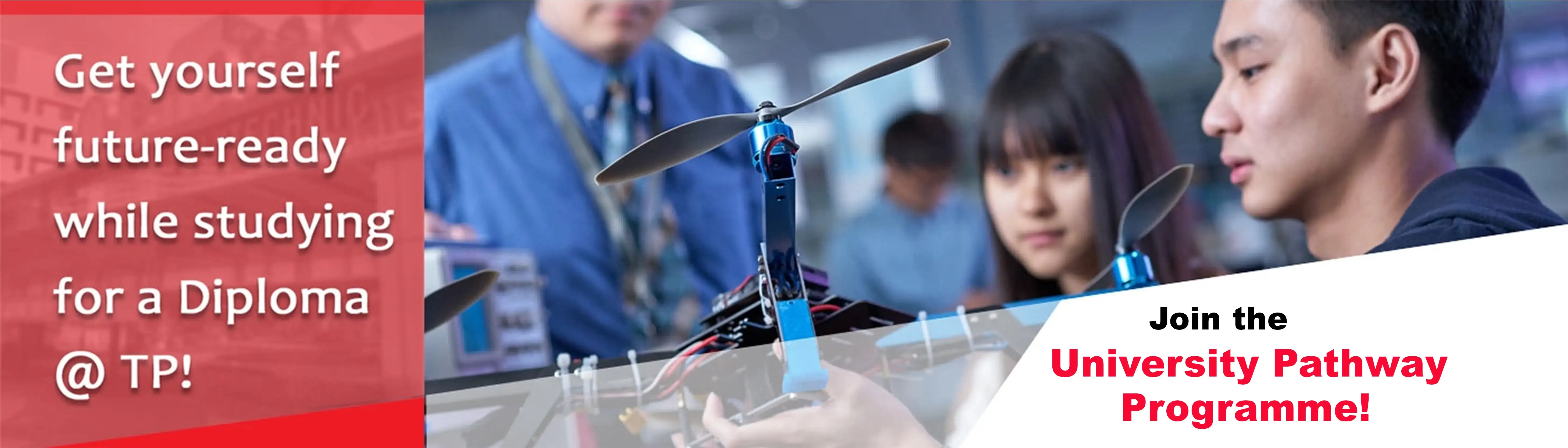
The TP-NUS/TP-SUTD University Pathway Programme allows you to take university modules during your final year of this diploma, and gain conditional admission into NUS/SUTD. This shortens the time needed for you to get your degree. You also get a taste of university life during your diploma studies at TP!
/eng-t65-8.webp)
Multi-disciplinary and experiential learning
You will receive authentic and multi-disciplinary experiential training in our high-tech research centres of excellence, working alongside skilled research engineers and learning from industry leaders such as Omron, PTC and Festo. This will make you future-ready to ride the wave of the digital transformation!
/ELNbox3.webp)
Wide array of career choices in various sectors
You will be groomed for an extremely wide variety of exciting careers in areas such as electronics, semiconductors, aerospace, AI, robotics, IoT, autonomous electrical vehicles, renewable energy, intra-logistics, bio-pharmaceuticals and healthcare. Your internship in Year 3 will give you the work experience needed to get a career head-start!
/STMPIcon(no-text)(July25).webp)
/OELPIcon(no-text)(July25).webp)
/OTEIcon(no-text)(July25).webp)
Entry Requirements
To be eligible for consideration for admission, applicants must obtain 26 points or better for the net ELR2B2 aggregate score (i.e. English Language, 2 relevant subjects and best 2 other subjects, including CCA Bonus Points) and meet the minimum entry requirements of this course. CCA cannot be used to meet the minimum entry requirements.
Subject
Grade
English Language (EL1)
1-7
Mathematics (E or A)
1-6
Any one of the following subjects
- Biology
- Biotechnology
- Chemistry
- Computing/Computer Studies
- Design & Technology
- Electronics/Fundamentals of Electronics
- Physics
- Science (Chemistry , Biology)
- Science (Physics, Biology)
- Science (Physics, Chemistry)
1-6
2027 Planned Intake
50
Note: Applicants should not be suffering from complete colour vision deficiency, uncontrolled epilepsy, profound hearing loss or severe vision impairment.
*SPM / UEC holders must have a minimum of grade 6 for the Bahasa Inggeris (English Language) subject.
Early Admissions Exercise (EAE)
Joint Admissions Exercise (JAE)
Joint Polytechnic Admissions Exercise (JPAE)
Direct Admissions Exercise (DAE)
- Year 1
- Year 2
- Year 3
- TPFUN
Acquire fundamental electronics knowledge and practical skills and learn to apply technical concepts in real-life applications related to smart nation applications, Internet of Things (IoT) technology, biomedical engineering, robotics and automation that are widely used today.
| Subject Code | Subject | Credit Units | ||
|---|---|---|---|---|
| EEE1001 | Circuit Analysis
This subject provides a good foundation in DC and AC network analysis. You will learn the basic principles of electric circuitry and how to apply circuit theorems to analyse DC and AC networks. |
5 | ||
| ESE1006 | Computer Programming for Problem Solving
This subject covers the process of decomposing a problem into a sequence of smaller abstractions. The abstractions are implemented in software in a structured top-down approach. Software implementation includes the process of designing, writing, testing, and debugging program code. |
4 | ||
| EEE1003 | Digital Fundamentals 1
This subject provides basic knowledge of digital electronics and circuits. Topics include number systems, operations and codes, logic gates, Boolean algebra and logic simplification, combinational logic, functional blocks, latches and flip-flops. |
5 | ||
| EEE1004 | Digital Fundamentals 2
This subject builds upon the fundamentals of digital electronics acquired in Digital Fundamentals 1. It introduces the digital concepts of the various building blocks in a computer’s digital system. You will acquire the theoretical and practical knowledge of registers, counters, memory devices, and conversions between digital and analogue signals and integrated circuit technologies. Digital troubleshooting techniques are also explored in the laboratory work. |
5 | ||
| EEE1002 | Electronic Devices & Circuits
This subject covers the theory and practical knowledge of electronic devices such as diodes, bipolar junction transistors, field effect transistors and their applications. It also focuses on the fundamentals of operational amplifiers and their applications, and the rudiments of circuit troubleshooting and testing. |
5 | ||
| EED1001 | Electronic Prototyping
This subject introduces you to the use of hand tools and standard laboratory equipment for the construction and testing of electronic prototypes. You will also learn to identify basic electronic components for project work and how to use them to build electronic devices. |
3 | ||
| EMA1003 | Engineering Mathematics 1
This subject teaches pre-calculus techniques required for an engineering course. It trains you in engineering problem-solving approaches using the appropriate mathematical tools. Topics such as simultaneous equations, matrices, trigonometric, exponential and logarithmic functions, complex numbers and vectors will be covered. |
4 | ||
| EMA1002 | Engineering Mathematics 2
This subject introduces the basic concepts of calculus and statistical method to test a hypothesis. Basic concepts in calculus include limits, derivatives and integrals. Applications of the derivative and integrals in engineering will be discussed. Basic statistical method in hypothesis testing includes normal distribution, confidence interval of population mean and procedure to test hypothesis for a claim made about a population mean. |
4 | ||
| ESC1004 | Engineering Physics
This subject covers a spectrum of fundamental physics laws and concepts applicable to the scope of engineering physics. It covers a few core areas including Mechanics, Energy, Thermal Physics, Electromagnetism, Waves & Optics and Materials. This subject provides a foundation for a further in depth study of the various engineering disciplines. |
3 |

Be trained to handle advanced electronics, connected devices, motors & drives, control systems, embedded systems and data analytics, while acquiring further practice-based skills which are relevant for the industry.
| Subject Code | Subject | Credit Units | ||
|---|---|---|---|---|
| ESE1009 | Artificial Intelligence in Engineering
This subject will cover the key concepts of Artificial intelligence (AI), Generative AI, and foundation models to prepare engineers for a future where AI applications will be pervasive. It will include considerations for the ethical and safe use of AI, as well as the impact of AI on engineering applications through real-world case studies. It will also cover essential AI techniques and Prompt Engineering skills, providing the foundation to leverage on AI for innovative solutions in engineering domains. The subject will provide skills practice for applications of AI for data augmentation, data analysis, prototyping and simulation, problem-solving and optimisation. |
2 | ||
| ESE1008 | Data Visualisation & Analytics
This subject covers the data analytics lifecycle, including gathering, cleaning, processing and visualising of data. Exploratory data analysis methods, descriptive and predictive analytics, and the presentation of insights, will also be covered. |
3 | ||
| EEE2003 | Electrical Installation Design
This subject covers basic electrical design work. It includes the principles and design of low voltage electrical systems in compliance with the relevant local statutory requirements and good engineering practices. It also covers the different types of electrical installation methods for buildings, as well as the design of grid-connected solar PV systems integrated with energy storage systems. |
4 | ||
| EEE2007 | Electronic Systems Design
This subject provides an in-depth exploration of the fundamental principles, components, circuits, and systems that drive modern electronic circuits. It covers the design, operation, and analysis of electronic circuits, digital sensors and embedded controller systems, emphasising practical skills in schematic creation, configuration, and troubleshooting / diagnostic techniques. |
4 | ||
| ECC2014 | Industrial IoT Analytics
This subject covers the essential concepts and skills needed for implementing digital transformation in smart manufacturing plants. It covers the application of industrial software platforms to wirelessly interconnect sensors, Internet of Things (IoT) devices and equipment. Students will learn to develop dashboard for acquiring, analysing and displaying data that is commonly found in Advanced Manufacturing. Modern approaches in activation of hardware and software responses when interventions are required for process improvement or corrective actions are also covered in detail. |
4 | ||
| EEE2005 | Integrated Circuit Applications
This subject covers the basic applications of integrated circuits (IC) which form the building blocks of field electronics. Apart from basic applications using operational amplifier (op-amp), the subject also covers other practical applications like active filters, clippers, clampers, comparators, timers and voltage regulators. |
3 | ||
| EMC3006 | Microcontroller Applications
This subject provides you with working knowledge on microcontroller architecture, the features and characteristics of the internal peripherals in the microcontroller, such as interrupts, Timer and PWM, in order to design and implement an embedded system that involves hardware and software interfacing. The subject also covers the features of evolving microcontrollers that support Internet of Things (IoT) applications. |
5 | ||
| EEE3004 | Power Electronics & Drives
This subject is an introduction to the study of machines, power semiconductor devices and their applications as power converters and motor drives. Topics covered include basic principles of DC and AC motors, fundamentals of controlled rectifiers and drives, principles of DC choppers and drives, and inverters. The uses of semiconductor devices in power applications and thermal effects on the performance of these devices due to high power will also be discussed. |
4 | ||
| EEE3006 | Smart Electronics & Connectivity
This subject is designed to provide you with comprehensive knowledge and practical skills in the field of next-generation smart electronic devices. It covers the technical skills required for applying smart sensors and machine learning algorithms to electronic devices to offer advanced featured beyond the basic functions. |
4 | ||
| EER3006 | Smart Grid Technology
This subject covers the operation of a power distribution network system in the transmission and distribution of electricity. Topics include system earthing, circuit breakers, fuses, cables, and transformers, as well as the different types of network protection schemes and fault calculations. In addition, you will be introduced to smart grid technologies, including the integration of renewable energy sources, digital monitoring systems, advanced metering infrastructure, and intelligent control solutions that enhance grid efficiency, resilience, and sustainability. |
4 |
Get an authentic workplace experience through your internship and prepare for the industry by working on a relevant Major Project. You can also specialise in one of our five cluster electives: Aerospace Electronics (Avionics), Industrial Artificial Intelligence, Robotics, Semiconductor Technology or Intralogistics & Cybersecurity.
| Subject Code | Subject | Credit Units | ||
|---|---|---|---|---|
| EMP3002 | Major Project
In this subject, you will work in teams to integrate and apply your skills and knowledge to implement your projects in a practical work-and-learn environment. Besides research, design, analytics, project management, communication and problem solving skills, the emphasis will also be on innovation, teamwork and self-learning. |
8 |
Cluster Elective Subjects
Students to choose one of these elective clusters
| Subject Code | Subject | Credit Units | ||
|---|---|---|---|---|
| EED3014 | Advanced Skills Practices
This subject provides opportunities for you to integrate and apply your knowledge for high level competitions or projects in practical learning situations. The project or skills training can involve substantial work related to either a high level industrial program or an end-user product, as well as advanced training to develop technical abilities to execute specific tasks competitively. It could also involve the development, evaluation of workable designs and implementation of ideas related to an innovative product suitable for manufacturing, or an improvement to existing products or processes. You may be required to work on software, hardware, or a combination of both hardware and software. |
8 |
| Subject Code | Subject | Credit Units | ||
|---|---|---|---|---|
| EAE3018 | Aircraft Digital Systems
This subject gives a general knowledge of the theoretical and practical aspects of aircraft digital fundamentals. It covers study in the area of electronic instrument systems, logic circuits, fibre optics, electronic displays, electronic sensitive devices, electromagnetic environment and digital aircraft systems as required by Singapore Airworthiness Requirements (SAR-66) of the Civil Aviation Authority of Singapore. The aims of this subject are to equip students with the knowledge and skills to:
|
4 | ||
| EAE1006 | Avionic Systems
This subject gives a broad overview of aircraft avionics and architecture at the system level, and provides a context for follow-on training. The subject introduces students to the key avionics deployed on-board an air transport aircraft, including the crew information systems, the safety and surveillance systems, the flight and engine control systems, the navigation systems as well as the communications and information systems. The aim of this subject is to equip students with the knowledge to have a good appreciation of the integrated avionic systems onboard an aircraft. |
4 |
| Subject Code | Subject | Credit Units | ||
|---|---|---|---|---|
| BLO2010 | Distribution Centre Management
This subject provides an overview of the role of a Distribution Centre (DC) in the supply chain. It also covers the various activities performed within a DC and the significance of these activities on customer service and total logistics costs. It focuses on the major resources to be applied in a DC and explains how they interact with one another in contributing to the DC’s effectiveness and efficiency. It will also cover the significance of providing DC services to the Third-Party Logistics industry. |
4 | ||
| CCF2C02 | IOT Security
This subject covers the knowledge and skills required to analyse and troubleshoot IoT vulnerabilities and threats. You will use latest technologies to perform risk assessments and recommend mitigation strategies for common security issues in IoT systems. |
4 |
| Subject Code | Subject | Credit Units | ||
|---|---|---|---|---|
| EER3007 | Power System Analysis
This subject covers how electrical power systems work in steady-state conditions as well as during faults. Topics include transmission lines, interconnected bus systems, load flow analysis, system stability and short circuit analysis. After completing this module, you will be ready to analyse and design industry software, and use it to model power networks and safely run low and medium voltage power systems. |
4 | ||
| EER3008 | Power Transmission & Distribution
This subject covers how electrical power is transmitted and distributed from generator to homes, businesses and industries. Topics include transmission, distribution, transformers, switchgears, cables (overhead/underground), power losses and protection settings. It will also cover renewable energy systems, distributed energy resources and compliance with local standards such as SS638 / SS551. |
4 |
| Subject Code | Subject | Credit Units | ||
|---|---|---|---|---|
| EMF3005 | Robotics Vision & Automation
This subject introduces you to the application of robotics, machine vision and automation in advanced manufacturing environments. You will learn robot programming and how robotic systems are integrated with automation to enable intelligent and flexible operations. The subject also provides a foundation in machine vision, covering key components, technologies, and principles used in vision systems. Emphasis is placed on how machine vision supports robotics and automation through functions such as inspection and quality control in modern production systems. |
4 | ||
| EMF2002 | Smart Manufacturing System
This subject introduces the core elements of a smart manufacturing system where real-time manufacturing data enables flexibility and increases productivity. An introduction to advanced manufacturing and key enabling technologies such as Radio Frequency Identification (RFID) systems, Manufacturing Executions Systems (MES) and Augmented Reality (AR) are used to lay the foundation for understanding the application and benefits of smart manufacturing. |
4 |
| Subject Code | Subject | Credit Units | ||
|---|---|---|---|---|
| EER3003 | Solar Photovoltaic Technology & Leasing
This subject introduces the design, installation, operation, maintenance of solar photovoltaic systems and the business model of implementing solar leasing. The topics include design, configuration, and installation of standalone and grid-tied solar photovoltaic systems, setting up of data acquisition as well as monitoring of energy performance indicators (ENPIs). Configuration of the balance of system in the grid-connected solar photovoltaic systems will also be explained in detail. In addition, a case study on commercial solar leasing will also be included as part of the learning activities. |
4 | ||
| EGT3001 | Green Urban Transportation & Energy Storage
This subject introduces you to sustainable green urban transportation in Singapore and why energy storage devices are crucial in green urban transportation. It will cover how Singapore plans to reduce carbon emissions in the transport sector through the adoption of electric vehicles. Topics include electric vehicles and greenhouse gas emission, electric vehicle working concepts, safety in handling electric vehicles, charging of electric vehicles and energy storage. |
4 |
| Subject Code | Subject | Credit Units | ||
|---|---|---|---|---|
| EED3015 | Guided Work-Based Learning
This is a guided learning subject that introduces students to industry transformation knowledge and skills in the area of Operational Technology (OT) and Information Technology (IT) in the context of major technical job roles in the industries. Students will work with their TP and company supervisors to chart out learning plan / contract and execute their individual workplace / project assignment, as well as monitor and reflect on their learning progress. The individual learning work-place/project assignment will be supported by acquisition of crucial knowledge and skill through relevant certification courses. |
8 |
| Subject Code | Subject | Credit Units | ||
|---|---|---|---|---|
| EER3004 | Electrical Engineering Principles & Practice
Real engineering systems will be used to show how engineers use different disciplines of engineering to make things work. Through grasping engineering fundamentals, you will learn how engineering systems work and fail. You will also learn basic design, experimentation and evaluation of engineering systems. |
4 | ||
| EMA3003 | Introductory Mathematics
At the end of the subject, you will be able to attain a level of proficiency in algebra and calculus equivalent to GCE A Level Mathematics. Major topics include: Sets, functions and graphs, polynomials and rational functions, inequalities in one variable, logarithmic and exponential functions, trigonometric functions, sequences and series, techniques of differentiation, applications of differentiation, maxima and minima, increasing and decreasing functions, curve sketching, techniques of integration, applications of integration, areas, volumes of solids of revolution, solution of first-order ordinary differential equations by separation of variables and by integrating factor, complex numbers and vectors. |
4 | ||
| ESC3003 | Fundamentals of Physics
This subject covers two branches of fundamental physics: mechanics and electricity & magnetism. Topics included in mechanics are linear motion, circular motion, Newton’s laws of motion, work and energy, conservation of energy, linear momentum, and simple harmonic motion. Topics included in electricity & magnetism are electric force, field & potential, current & resistance, DC circuits, electromagnetism and electromagnetic induction. |
4 | ||
| ESE3016 | Programming Methodology
This subject introduces the fundamental concepts of problem solving by computing and programming using an imperative programming language. It is the first and foremost introductory course to computing. Topics covered include computational thinking and computational problem solving, designing and specifying an algorithm, basic problem formulation and problem-solving approaches, program development, coding, testing and debugging, fundamental programming constructs (variables, types, expressions, assignments, functions, control structures, etc.), fundamental data structures (arrays, strings, composite data types), basic sorting, and recursion. |
4 |
| Subject Code | Subject | Credit Units | ||
|---|---|---|---|---|
| ECD3001 | Social Science: Understanding Behaviour, Culture & Society
This subject strives to cultivate an understanding of core issues, fundamental theories and philosophical stances in the social sciences, and explores the manner in which social scientists formulate questions about society that can be addressed with empirical research. |
4 | ||
| EMA3002 | Modelling & Analysis
The main objective of this subject is to provide students firm foundations of single variable calculus so that they can apply calculus to model, solve and analyse applied math problems. It aims to motivate students on the importance of calculus through a plethora of applications in engineering, physical and biological sciences, computer science, finance, economics, probability and statistics and other topics. On top of the basic concepts, techniques and applications of two branches of calculus - differentiation and integration, students will also learn to use simple software to implement numerical methods in calculus. |
4 | ||
| ESC3002 | Physical World
This subject provide students with the ability to understand and explain the inner mechanism of the physical world based on the principles of mechanics and thermodynamics. It aims to help students appreciate the beauty of physics and enable them to apply key concepts learnt to evaluate and address physics-based problems to make a positive impact on the world. By using concepts established through simplified mathematical models, reverse engineering case studies and experiential learning through hands-on demonstrations, connections between physics concepts and theoretical models are reinforced with practice. |
4 | ||
| ESE3015 | Computational Thinking for Design
This subject covers programming both in the architectural design and computing contexts targeted at novice programmers. It will introduce students to programming and design computing skills that are essential for their studies. Students will learn visual programming and python programming together with design concepts, and will apply these skills in related projects. |
4 |
| Subject Code | Subject | Credit Units | ||
|---|---|---|---|---|
| ECC3013 | Algorithms & Programming
This module covers fundamental programming concepts using Java or Python, covering data structures, algorithmic paradigms like Divide & Conquer and Dynamic Programming, and their application in problem-solving and data science. |
4 | ||
| EBZ3012 | Business Process Analysis & Solutioning
This module covers business process modelling and analysis. The goal is to identify the gaps in the business workflow and recommend the solutions based on technology solutioning or restructuring the workflows for process optimization. The course will ensure that you can smoothly translate enterprise business objectives into an effective IT solution architecture. Business process innovation has become a growing interest of several sectors due to the exponential growth of new technologies such as social media, big data, analytics, machine learning, IoTs and artificial intelligence. You will be exposed to the various technologies and their role in process innovation. |
4 |
| Subject Code | Subject | Credit Units | ||
|---|---|---|---|---|
| EMA3004 | Mathematical Foundations of Computing
This module teaches introduction to the theory of discrete mathematics, which lays the foundation for computer science courses such as data structures, algorithms, relational database theory and cryptography. The topics covered in this course are mathematical logic, elementary number theory, recursion, set theory, functions, combinatorics and graphs. The course will consist of lectures and tutorials to help you understand the covered topics. |
4 | ||
| ECC3012 | Collaborative Software Development
This module covers software construction, software design issues, agile processes and project management techniques. The focus is to allow you to experience agile software development and project management by working in a team to develop a Java based web application. |
4 |
| Subject Code | Subject | Credit Units | ||
|---|---|---|---|---|
| ECC3013 | Algorithms & Programming
This module covers fundamental programming concepts using Java or Python, covering data structures, algorithmic paradigms like Divide & Conquer and Dynamic Programming, and their application in problem-solving and data science. |
4 | ||
| ECC3014 | Operating Systems & Networking
This module covers fundamental knowledge in computing, and you can further specialise in areas such as Cybersecurity, Cloud Computing, and Internet of Things (IoT), all of which have strong ties to operating systems and networking concepts. |
4 |
| Subject Code | Subject | Credit Units | ||
|---|---|---|---|---|
| EMI3011 | Cleanroom & Vacuum Technology
This subject introduces the topics vacuum & plasma technologies as well as industry good practices of contamination control in a cleanroom work environment, complete with wafer processing and metrology equipment, deionised water system and specialty gas facilities. It also covers comprehensive vacuum systems which are configured with different vacuum pumps, pressure gauges, pressure and flow controllers and plasma systems. |
5 | ||
| EMI3010 | Wafer Fabrication Technology
The subject gives an overview of the semiconductor industry, basic concepts of Integrated Circuit (IC), IC fabrication and wafer fabrication. Wafer fabrication process flow, conceptual mask layouts and their relevant test structures for fabricating electronic devices and IC will be covered. This subject also covers the basic concepts of process in-line monitoring and characterisation of basic devices. In addition, various processes of IC wafer fabrication, such as doping, photolithography, etching, thin film, and chemical mechanical polishing will be covered. The fundamentals of Statistical Process Control related to wafer fabrication will also be introduced. |
5 |
Special Electives
Students can opt to take Special Electives when offered. These optional subjects aim to stretch the students' potential to enable them meet their aspirations. They are taken in addition to the diploma cluster elective subjects.
| Subject Code | Subject | Credit Units | ||
|---|---|---|---|---|
| EED3009 | Special Project 1
The focus of this subject is on the application of students’ existing domain knowledge to develop a deliverable. The subject will introduce new skills and knowledge specific to the project, as and when required. |
2 | ||
| EED3010 | Special Project 2
This subject provides opportunities for students to apply the acquired knowledge and skills, along with their fundamental and in-depth knowledge from different subjects to designing, developing, and implementing a well-engineered project solution. |
2 | ||
| EED3011 | Higher Engineering Skills 1
Higher Engineering Skills 1 and 2 aim to impart some special design and hands-on skills that allow you to acquire knowledge and skills that are not normally incorporated into a diploma programme. These Special Elective subjects will equip you with the skills and knowledge to participate in competitions and enable you to tackle real challenges. |
2 | ||
| EED3012 | Higher Engineering Skills 2
Higher Engineering Skills 1 and 2 aim to impart some special design and hands-on skills that allow you to acquire knowledge and skills that are not normally incorporated into a diploma programme. These Special Elective subjects will equip you with the skills and knowledge to participate in competitions and enable you to tackle real challenges. |
2 | ||
| EMA3001 | Higher Engineering Mathematics
The subject introduces mathematical concepts and techniques used in advanced engineering courses. You will learn topics in calculus such as limits and continuity, infinite series, improper integrals, multiple integrals, higher order differential equations, 2D and 3D analytic geometry, and partial differentiation. |
4 |
You will also take this set of subjects that equips you with the crucial 21st-century life skills you need to navigate the modern world as an agile, forward-thinking individual and team player.
| Subject Code | Subject | Credit Units | ||
|---|---|---|---|---|
| GTP1103 | Effective Personal Leadership
This subject examines self-management and self-leadership through an exploration of values and beliefs, necessary for adapting to the world of work. It covers topics such as self-management and awareness, values and ethics, interpersonal communication, teamwork, resilience and emotional intelligence for enhancing leadership capabilities. These can significantly influence careers, relationships, and overall well-being. This subject is a reflective exploration of ‘leadership from within’ to have a greater awareness for the development of attributes required in an effective values-centred leader for oneself and for others. |
3 | ||
| GTP1203 | Career Readiness & Communication
This subject equips students with career preparation skills through better understanding of their career interests, values, skills and aspirations. Topics covered include personal branding, job search strategies, resume and cover letter writing, and interview techniques. In addition, students will gain awareness of workplace communication to succeed in their careers and achieve professional goals. |
3 | ||
| GTP1303 | Current Issues & Critical Thinking
This subject provides a comprehensive introduction to critical thinking by engaging students with current local and global issues. Students will learn to analyse diverse perspectives and uncover underlying assumptions in opinions, evaluate the credibility and bias of information sources, and construct well-reasoned, evidence-based arguments using established critical-thinking frameworks. They will also assess the societal, ethical, and personal implications of contemporary problems, and develop the ability to communicate their conclusions clearly and persuasively, employing appropriate digital tools to support their ideas. |
4 | ||
| INV1001 | Innovation & Entrepreneurship
The subject is designed for learners from all disciplines to embrace innovation in either their specialised field or beyond. Learners will be taught to apply the Design Thinking framework to develop problem statements, ideate and identify feasible solutions. Learners will be exposed to several tools for prototyping. In addition, commercial awareness will be imbued in learners through various innovation and entrepreneurship concepts or tools. This subject also prepares students to be self-directed lifelong learners who are digital and information literate. It nurtures communicative and collaborative citizens who can use objective analysis in problem-solving. |
2 | ||
| LSW1002 | Sports & Wellness
This subject reinforces the fundamental knowledge learnt on health, fitness, exercise and sports. Hands-on time will be allocated for a greater variety of fitness exercises and sports skills in a recreational setting. In addition, theoretical knowledge such as sports safety and risk management when participating in physical activities will be introduced. Guidance will be provided for improvement of physical fitness, acquiring of sports skills and relating theoretical knowledge to the physical activities. |
2 | ||
| TGS1002 | Global Studies
This subject provides essential skills and knowledge to prepare students for an overseas experience. They will examine the elements of culture and learn the key principles of cross-cultural communication. In addition, they will gain an appreciation and awareness of the political, economic, technological and social landscape to function effectively in a global environment. The subject prepares students to be responsible global citizens and leaders who can contribute to the global community through effective communication and collaboration. |
3 | ||
| TGS1003 | Sustainability & Climate Action
This subject prepares students to be responsible global citizens and future leaders who can contribute to the global community. It introduces the topics of sustainability and explores how human societies can act to build a sustainable future. This subject focuses on the impact of climate change, potential solutions to climate change, and the future of the green economy from global and local perspectives. |
3 | ||
| ESI3003 | Student Internship Programme
This structured programme is designed to link your learning with the real work environment. You will be placed in organisation(s) with opportunities to apply the concepts and skills acquired in the course of your study. Besides reinforcing technical concepts and mastering of skills in areas that you have been trained, the practical training will enable you to build important skills such as problem-solving, communication, teamwork, and to cultivate good attitude and a strong work ethic. |
16 |
| Subject Code | Subject | Credit Units | ||
|---|---|---|---|---|
| GTP1304 | Beyond the Classroom: Guided Learning
This subject empowers students to take charge of their personal learning in a chosen area of inquiry. Students will broaden or deepen their knowledge and skills, fostering a proactive approach to lifelong learning. Following a scaffolded process, students will design and execute a personalised learning plan that extends beyond traditional classroom walls. The journey culminates in a curated portfolio that highlights their achievements and growth. |
3 |
Graduation Requirements
Cumulative Grade Point Average
min 1.0
TP Fundamentals Subjects
min 36 credit units
Diploma Core Subjects
83 credit units
Diploma Cluster Elective Subjects
7 credit units
Total Credit Units Completed
min 126 credit units
Career Prospects
In Singapore, the Electronics industry employs more than 68,000 workers, with the figure set to increase as more semiconductor facilities are being built.
With this diploma, you will have excellent and flexible career prospects in the consumer & industrial electronics, aerospace, robotics & automation, semiconductor, land transport, bio-pharmaceuticals, energy & power/chemicals, healthcare, telecommunications, instrumentation & control, computing, retail and logistic industries.
Potential jobs for you include:
/Isabel%20koh%201.webp)
"This hands-on focus in this course gave me valuable practical skills and taught me to think out of the box to solve problems systematically. I also enjoyed taking part in CCA activities which gave me countless opportunities for self-growth.”
Isabel Judith Koh (2021)
A*STAR Science Award scholarship recipient, 2021
/Nathaniel%20Yoong.webp)
“This course has not only honed my knowledge and skills-sets, but also moulded my perseverance, people management skills, and leadership qualities. It also gave me a strong foundation that earned me direct entry into Year 2 of my university course.”
Nathaniel Yoong (2021)
Bachelor of Engineering, NTU
JT Legal LLC
/AlpanaRai.webp)
“My diploma course exposed me to problem-based learning and taught me that one issue can have many solutions, just as there are multiple ways to solve a problem in life. I am grateful that my diploma enabled me to land a dream job in the electronics sector.”
Alpana Rai (2020)
Technologist
Micron Inc.
/eng-t13-tn.webp)
/eng-t66-tn.webp)
/eng-t56-tn.webp)
Contact
- enghotline@tp.edu.sg
- Website: https://www.tp.edu.sg/eng
-
School of Engineering
Temasek Polytechnic
West Wing Block 10-25A, 32-33
21 Tampines Ave 1
Singapore 529757