You will take four Core Modules and two Cluster Modules each semester. These modules are meant to prepare you for your diploma years.
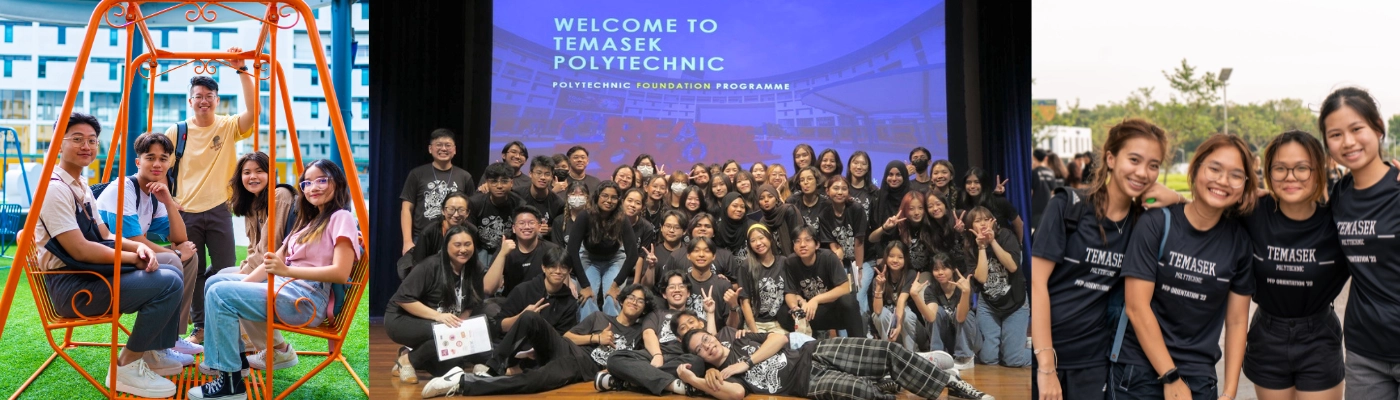
Polytechnic Foundation Programme


Course Overview
The Polytechnic Foundation Programme (PFP@TP) is a one-year programme provided by the Centre for Foundation Studies to provide a head start for the top Secondary 4 Normal (Academic) students at the Singapore-Cambridge GCE N(A) Level Examinations in Temasek Polytechnic. Instead of taking the GCE O-Level Examinations in Secondary 5, eligible students can join PFP@TP before admission to their pre-selected diploma courses.
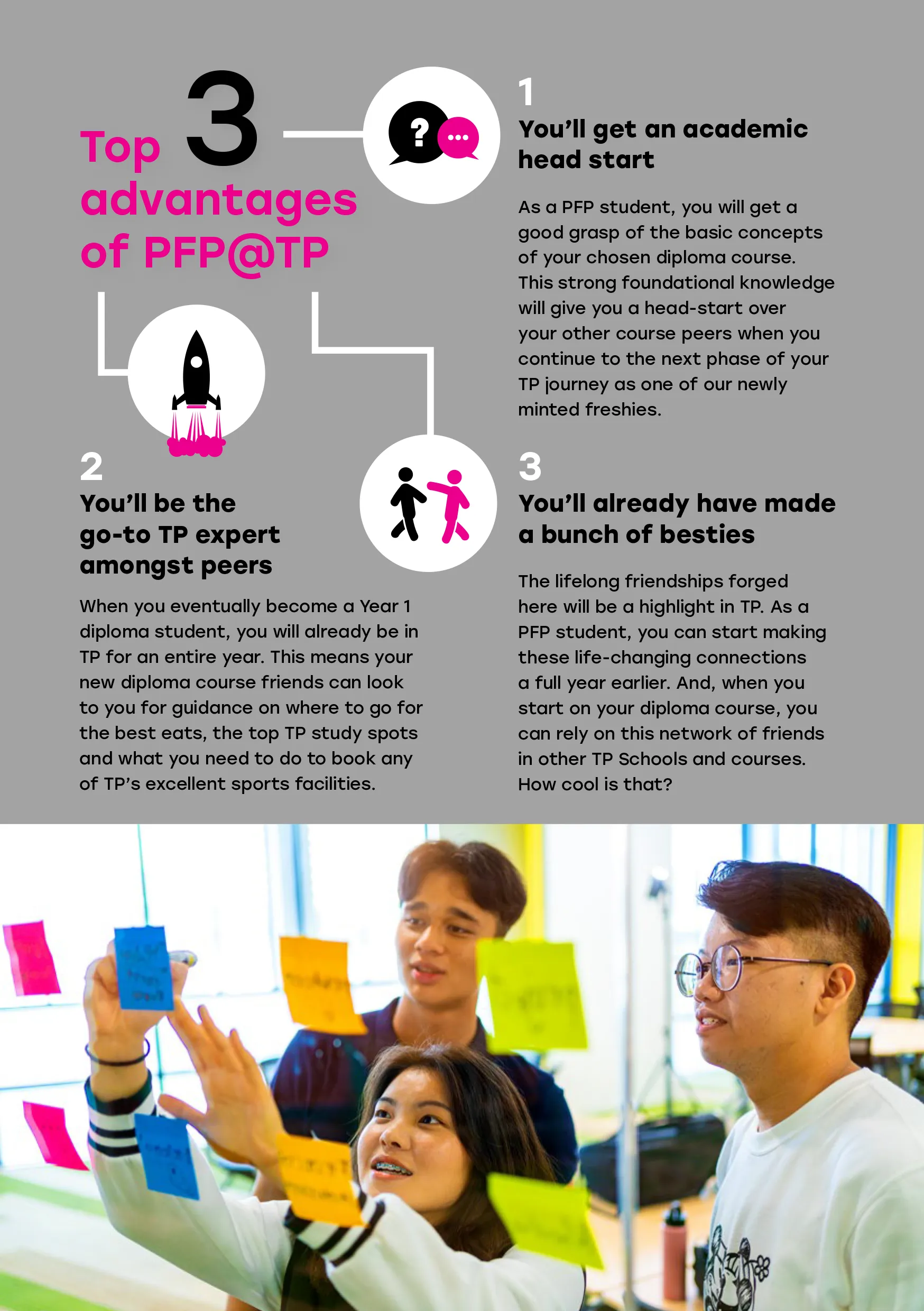
Following TP’s academic calendar which runs in two semesters, the PFP curriculum is delivered in an engaging manner through small groups that foster personalised attention and collaborative learning. This conducive classroom environment allows for meaningful interaction with lecturers and peers, ensuring you receive the support needed to excel academically while building lasting friendships within your TPFam community.
Starting in AY2026/2027, students can choose a cluster and select their preferred diploma at the end of the PFP year through the Cluster-based Admission.
Choose from the following clusters at PFP@TP:
Apply directly to the following course:
Download the brochures below for admission details specific to each academic year:
Course Listings by PFP Clusters
* Conducted by the National Institute of Early Childhood Development (NIEC), in collaboration with TP at the NIEC (TP) campus. For more information on NIEC, visit www.niec.edu.sg
Entry Requirements
Secondary 4 N(A) students who are eligible for the PFP will be invited to apply through the Polytechnic Foundation Programme Admission Exercise (PFPAE) in January.
You should first progress to Secondary 5 before the commencement of the application process.
Eligible N(A) students who have done well for Singapore-Cambridge GCE N(A) Level examination can choose a cluster or sub-cluster for PFP. After passing the PFP year, you will be posted to a specific polytechnic Year 1 course within the cluster. Posting will be based on merit and course choice.
To be eligible to apply for the PFP, N(A) students must:
- Obtain ELMAB3 (English Language, Mathematics, Best 3 subjects) raw aggregate score of 12 points or better (excluding CCA bonus point) at the GCE N(A) Level examination; and
- Meet the following subject-specific requirements:
Sciences Cluster
|
Humanities, Arts, Media & Business Cluster |
||
|---|---|---|---|
Subject |
Minimum Required Grade |
Subject |
Minimum Required Grade |
English Language Syllabus A
|
3 |
English Language Syllabus A |
3 |
Mathematics (Syllabus A / Additional)
|
3 |
Mathematics (Syllabus A / Additional) |
3 |
One of the following relevant subjects:
|
3 |
One of the following relevant subjects:
|
3 |
Any two other subjects, excluding CCA
|
4 |
Any two other subjects, excluding CCA |
4 |
- Sciences
- Engineering & Technology
- Design
- Humanities, Arts, Media & Business
- Early Childhood Development & Education
| Subject Code | Subject | Credit Units | ||
|---|---|---|---|---|
| KLS1C01 | Essential Life Skills 1
This subject aims to cultivate students' abilities in maintaining personal effectiveness and explore the impact of social awareness on interpersonal relationships and effective collaboration and communication in teamwork. With support provided in the domains of Education and Career Guidance (ECG), students will develop the capacity to identify their interests, aptitudes, and strengths as they shape their career self-concept. |
3 | ||
| LHF1001 | Health & Fitness 1
The subject introduces to students the fundamental knowledge on health, fitness, exercise and sports. Topics such as nutrition and weight management and basic principles of exercise will be included. Students will be exposed to a variety of sports and outdoor activities in a recreation setting. Guidance will be provided to improve physical fitness, acquire sports skills and relate theoretical knowledge to the physical activities. |
2 | ||
| KEL1S01 | English Language & Communication 1
This subject aims to establish a strong language foundation for students in listening, speaking, reading, and writing. It explores various written and spoken texts from print and non-print sources, focusing on reading, listening, speaking, and writing skills. Additionally, it includes skills for interpreting and expressing messages across different modalities. |
7 | ||
| KFM1S01 | Foundation Mathematics 1
This subject aims to equip students with basic mathematical knowledge that would be useful and relevant for a wide range of applications in the SC and E&T clusters. The baseline common topics include Algebraic Manipulation, Functions and Graphs and Trigonometry. Differentiation has been included as the additional topic to enhance the domain mathematical skills for students in the SC as well as E&T clusters. |
6 |

| Subject Code | Subject | Credit Units | ||
|---|---|---|---|---|
| ABM1F03 | Cell Biology & Microbiology
This subject covers basic concepts in cell and cellular organization, genetics and microbiology, as well as basic laboratory skills in life science. |
4 | ||
| ACH1F03 | Principles of Chemistry
The subject introduces students to the fundamental concepts in physical and inorganic chemistry and basic chemical laboratory skills. Topics included are atomic structure, chemical bonding, stoichiometry and mole concept, chemical reactions, properties of acids, bases and salts, periodic table and periodicity. |
5 |
| Subject Code | Subject | Credit Units | ||
|---|---|---|---|---|
| KLS1C02 | Essential Life Skills 2
This subject aims to familiarise students with cultural and social differences in society, allowing them to cultivate an awareness and sensitivity towards prevalent societal and community issues. In a bid to develop students holistically in their personal and professional development, students will be exposed to information about the different sectors within the cluster via ECG to make an informed decision on their choice of diploma. |
3 | ||
| LHF1002 | Health & Fitness 2
The subject reinforces the fundamental knowledge learnt on health, fitness, exercise and sports. In addition, topics such as sports safety and risk management when participating in physical activities will be introduced. Students will be exposed to a greater variety of sports and outdoor activities in a recreation setting. Guidance will be provided to improve physical fitness, acquire sports skills and relate theoretical knowledge to the physical activities. |
2 | ||
| KEL1S02 | English Language & Communication 2
This subject continues with laying on to the foundational English Language skills from ELC1. ELC2 will introduce students to critical reading and listening and persuasive writing and speaking. It develops students' language skills to critically engage with texts in different formats and exposes them to authentic communicative tasks which are tasks that emphasise the use of language, through simulated real-life communication scenarios, for effective communication in the various clusters. |
7 | ||
| KFM1S02 | Foundation Mathematics 2
This subject exposes students to tasks that develop their logical reasoning and thinking skills, and problem-solving skills through the learning and application of mathematics in SC as well as E&T clusters.The baseline common topics include Vectors, Sets and Probability. Matrices has been included as the additional topic to enhance the domain mathematical skills for students in SC as well as E&T clusters. |
6 |
| Subject Code | Subject | Credit Units | ||
|---|---|---|---|---|
| CFP1S01 | Fundamentals of Digital Skills
This subject builds students’ foundation in digital skills and introduces them to Computer Systems and the Internet. Students will learn to use essential digital tools to communicate and collaborate with one another as well as analyse and visualise data. The module also covers cyber wellness and data privacy, aiming to cultivate behaviours for the appropriate and responsible use of technology. |
4 | ||
| ABM1F04 | Biochemistry & Human Biology
This subject introduces the fundamental concepts and skills in biochemistry and human anatomy and physiology. It also introduces the physical and chemical properties of alkanes, alkenes, alcohols, and carboxylic acids. |
5 |
You will take four Core Modules and two Cluster Modules each semester. These modules are meant to prepare you for your diploma years.
| Subject Code | Subject | Credit Units | ||
|---|---|---|---|---|
| KLS1C01 | Essential Life Skills 1
This subject aims to cultivate students' abilities in maintaining personal effectiveness and explore the impact of social awareness on interpersonal relationships and effective collaboration and communication in teamwork. With support provided in the domains of Education and Career Guidance (ECG), students will develop the capacity to identify their interests, aptitudes, and strengths as they shape their career self-concept. |
3 | ||
| LHF1001 | Health & Fitness 1
The subject introduces to students the fundamental knowledge on health, fitness, exercise and sports. Topics such as nutrition and weight management and basic principles of exercise will be included. Students will be exposed to a variety of sports and outdoor activities in a recreation setting. Guidance will be provided to improve physical fitness, acquire sports skills and relate theoretical knowledge to the physical activities. |
2 | ||
| KEL1T01 | English Language & Communication 1
This subject aims to establish a strong language foundation for students in listening, speaking, reading, and writing. It explores various written and spoken texts from print and non-print sources, focusing on reading, listening, speaking, and writing skills. Additionally, it includes skills for interpreting and expressing messages across different modalities. |
7 | ||
| KFM1T01 | Foundation Mathematics 1
This subject aims to equip students with basic mathematical knowledge that would be useful and relevant for a wide range of applications in the SC and E&T clusters. The baseline common topics include Algebraic Manipulation, Functions and Graphs and Trigonometry. Differentiation has been included as the additional topic to enhance the domain mathematical skills for students in the SC as well as E&T clusters. |
6 |
| Subject Code | Subject | Credit Units | ||
|---|---|---|---|---|
| DPF1051 | Fundamentals of Innovation by Design
This module initiates students in the practice and process of Innovation by Design. Students will learn how to ideate by identifying issues and problems. They will integrate the practice of research, analysis and practice organising information to create innovative design in a collaborative manner. The main goals of the module are to set the context of design process as continuous, iterative cycles of exploration, reflection, implementation and validation of design solutions. |
4 | ||
| EES1F03 | Physics in Daily Life
This subject will provide the core physics knowledge on kinematics and mechanics which include the study of the motion of objects, Newton’s Laws, moments, and energy. In addition, this subject covers topics like basic electric circuit principles, magnetism, and wave properties. |
5 |
| Subject Code | Subject | Credit Units | ||
|---|---|---|---|---|
| KLS1C02 | Essential Life Skills 2
This subject aims to familiarise students with cultural and social differences in society, allowing them to cultivate an awareness and sensitivity towards prevalent societal and community issues. In a bid to develop students holistically in their personal and professional development, students will be exposed to information about the different sectors within the cluster via ECG to make an informed decision on their choice of diploma. |
3 | ||
| LHF1002 | Health & Fitness 2
The subject reinforces the fundamental knowledge learnt on health, fitness, exercise and sports. In addition, topics such as sports safety and risk management when participating in physical activities will be introduced. Students will be exposed to a greater variety of sports and outdoor activities in a recreation setting. Guidance will be provided to improve physical fitness, acquire sports skills and relate theoretical knowledge to the physical activities. |
2 | ||
| KEL1T02 | English Language & Communication 2
This subject continues with laying on to the foundational English Language skills from ELC1. ELC2 will introduce students to critical reading and listening and persuasive writing and speaking. It develops students' language skills to critically engage with texts in different formats and exposes them to authentic communicative tasks which are tasks that emphasise the use of language, through simulated real-life communication scenarios, for effective communication in the various clusters. |
7 | ||
| KFM1T02 | Foundation Mathematics 2
This subject exposes students to tasks that develop their logical reasoning and thinking skills, and problem-solving skills through the learning and application of mathematics in SC as well as E&T clusters.The baseline common topics include Vectors, Sets and Probability. Matrices has been included as the additional topic to enhance the domain mathematical skills for students in SC as well as E&T clusters. |
6 |
| Subject Code | Subject | Credit Units | ||
|---|---|---|---|---|
| CFP1T01 | Fundamentals of Digital Skills
This subject builds students’ foundation in digital skills and introduces them to Computer Systems and the Internet. Students will learn to use essential digital tools to communicate and collaborate with one another as well as analyse and visualise data. The module also covers cyber wellness and data privacy, aiming to cultivate behaviours for the appropriate and responsible use of technology. |
4 | ||
| EES1F04 | Digital Logic & Programming
This subject provides an overview of digital logic for computing, and software development using a high-level programming language. It covers the basics of programming for the development of simple applications. |
5 |
You will take four Core Modules and two Cluster Modules each semester. These modules are meant to prepare you for your diploma years.
| Subject Code | Subject | Credit Units | ||
|---|---|---|---|---|
| KLS1C01 | Essential Life Skills 1
This subject aims to cultivate students' abilities in maintaining personal effectiveness and explore the impact of social awareness on interpersonal relationships and effective collaboration and communication in teamwork. With support provided in the domains of Education and Career Guidance (ECG), students will develop the capacity to identify their interests, aptitudes, and strengths as they shape their career self-concept. |
3 | ||
| LHF1001 | Health & Fitness 1
The subject introduces to students the fundamental knowledge on health, fitness, exercise and sports. Topics such as nutrition and weight management and basic principles of exercise will be included. Students will be exposed to a variety of sports and outdoor activities in a recreation setting. Guidance will be provided to improve physical fitness, acquire sports skills and relate theoretical knowledge to the physical activities. |
2 | ||
| KEL1D01 | English Language & Communication 1
This subject aims to establish a strong language foundation for students in listening, speaking, reading, and writing. It explores various written and spoken texts from print and non-print sources, focusing on reading, listening, speaking, and writing skills. Additionally, it includes skills for interpreting and expressing messages across different modalities. |
7 | ||
| KFM1D01 | Foundation Mathematics 1
This subject aims to equip students with basic mathematical knowledge that would be useful and relevant for a wide range of applications in DES and HAMB clusters. The common baseline topics include Algebraic Manipulation, Functions and Graphs and Trigonometry. Statistics has been included as the additional topic to enhance the domain mathematical skills for students in the DES as well as HAMB clusters. |
6 |
| Subject Code | Subject | Credit Units | ||
|---|---|---|---|---|
| DPF1051 | Fundamentals of Innovation by Design
This module initiates students in the practice and process of Innovation by Design. Students will learn how to ideate by identifying issues and problems. They will integrate the practice of research, analysis and practice organising information to create innovative design in a collaborative manner. The main goals of the module are to set the context of design process as continuous, iterative cycles of exploration, reflection, implementation and validation of design solutions. |
4 | ||
| DPF1049 | Design Fundamentals Studio
The aim of this module is to provide an introduction to students who aspire to work in the creative industry, with the knowledge of the Elements of Visual Art and the Principles of Design to understand how it can be applied into creating visually compelling and meaningful designs. Students will develop an awareness of how creative work is undertaken in a studio environment while developing strong fundamental design skills. |
5 |
| Subject Code | Subject | Credit Units | ||
|---|---|---|---|---|
| KLS1C02 | Essential Life Skills 2
This subject aims to familiarise students with cultural and social differences in society, allowing them to cultivate an awareness and sensitivity towards prevalent societal and community issues. In a bid to develop students holistically in their personal and professional development, students will be exposed to information about the different sectors within the cluster via ECG to make an informed decision on their choice of diploma. |
3 | ||
| LHF1002 | Health & Fitness 2
The subject reinforces the fundamental knowledge learnt on health, fitness, exercise and sports. In addition, topics such as sports safety and risk management when participating in physical activities will be introduced. Students will be exposed to a greater variety of sports and outdoor activities in a recreation setting. Guidance will be provided to improve physical fitness, acquire sports skills and relate theoretical knowledge to the physical activities. |
2 | ||
| KEL1D02 | English Language & Communication 2
This subject continues with laying on to the foundational English Language skills from ELC1. ELC2 will introduce students to critical reading and listening and persuasive writing and speaking. It develops students' language skills to critically engage with texts in different formats and exposes them to authentic communicative tasks which are tasks that emphasise the use of language, through simulated real-life communication scenarios, for effective communication in the various clusters. |
7 | ||
| KFM1D02 | Foundation Mathematics 2
This subject exposes students to tasks that develop their logical reasoning and thinking skills, and problem-solving skills through the learning and application of mathematics in DES and HAMB clusters. The baseline common topics include Vectors, Sets and Probability. Statistical distribution has been included as the additional topic to enhance the domain mathematical skills for students in DES as well as HAMB clusters. |
6 |
| Subject Code | Subject | Credit Units | ||
|---|---|---|---|---|
| CFP1D01 | Fundamentals of Digital Skills
This subject builds students’ foundation in digital skills and introduces them to Computer Systems and the Internet. Students will learn to use essential digital tools to communicate and collaborate with one another as well as analyse and visualise data.The module also covers cyber wellness and data privacy, aiming to cultivate behaviours for the appropriate and responsible use of technology. |
4 | ||
| DPF1050 | Digital Design Studio
This module covers the basic knowledge and skills needed for graphics-creation, image-editing and desktop-publishing. The subject provides an essential overview knowledge for facilitating digital execution for the design industry. Students will be introduced to the digital studio environment to work on various forms of digital media so that they are aware of current practices. |
4 |
You will take four Core Modules and two Cluster Modules each semester. These modules are meant to prepare you for your diploma years.
*These Clusters have 3 instead of 2 Cluster Modules in semester 2, however, the overall curricula hours remain the same as other Clusters.
| Subject Code | Subject | Credit Units | ||
|---|---|---|---|---|
| KLS1C01 | Essential Life Skills 1
This subject aims to cultivate students' abilities in maintaining personal effectiveness and explore the impact of social awareness on interpersonal relationships and effective collaboration and communication in teamwork. With support provided in the domains of Education and Career Guidance (ECG), students will develop the capacity to identify their interests, aptitudes, and strengths as they shape their career self-concept. |
3 | ||
| LHF1001 | Health & Fitness 1
The subject introduces to students the fundamental knowledge on health, fitness, exercise and sports. Topics such as nutrition and weight management and basic principles of exercise will be included. Students will be exposed to a variety of sports and outdoor activities in a recreation setting. Guidance will be provided to improve physical fitness, acquire sports skills and relate theoretical knowledge to the physical activities. |
2 | ||
| KEL1H01 | English Language & Communication 1
This subject aims to establish a strong language foundation for students in listening, speaking, reading, and writing. It explores various written and spoken texts from print and non-print sources, focusing on reading, listening, speaking, and writing skills. Additionally, it includes skills for interpreting and expressing messages across different modalities. |
7 | ||
| KFM1H01 | Foundation Mathematics 1
This subject aims to equip students with basic mathematical knowledge that would be useful and relevant for a wide range of applications in DES and HAMB clusters. The common baseline topics include Algebraic Manipulation, Functions and Graphs and Trigonometry. Statistics has been included as the additional topic to enhance the domain mathematical skills for students in the DES as well as HAMB clusters. |
6 |
| Subject Code | Subject | Credit Units | ||
|---|---|---|---|---|
| BBS1F03 | Fundamentals of Business 1
Fundamentals of Business 1 is an introductory module designed to introduce students to the basics of business enterprises through the lens of a company. This module covers key business terminologies, foundational concepts, and practices within the business environment. |
5 | ||
| CFP1H01 | Fundamentals of Digital Skills
This subject builds students’ foundation in digital skills and introduces them to Computer Systems and the Internet. Students will learn to use essential digital tools to communicate and collaborate with one another as well as analyse and visualise data. The module also covers cyber wellness and data privacy, aiming to cultivate behaviours for the appropriate and responsible use of technology. |
4 |
| Subject Code | Subject | Credit Units | ||
|---|---|---|---|---|
| KLS1C02 | Essential Life Skills 2
This subject aims to familiarise students with cultural and social differences in society, allowing them to cultivate an awareness and sensitivity towards prevalent societal and community issues. In a bid to develop students holistically in their personal and professional development, students will be exposed to information about the different sectors within the cluster via ECG to make an informed decision on their choice of diploma. |
3 | ||
| LHF1002 | Health & Fitness 2
The subject reinforces the fundamental knowledge learnt on health, fitness, exercise and sports. In addition, topics such as sports safety and risk management when participating in physical activities will be introduced. Students will be exposed to a greater variety of sports and outdoor activities in a recreation setting. Guidance will be provided to improve physical fitness, acquire sports skills and relate theoretical knowledge to the physical activities. |
2 | ||
| KEL1H02 | English Language & Communication 2
This subject continues with laying on to the foundational English Language skills from ELC1. ELC2 will introduce students to critical reading and listening and persuasive writing and speaking. It develops students' language skills to critically engage with texts in different formats and exposes them to authentic communicative tasks which are tasks that emphasise the use of language, through simulated real-life communication scenarios, for effective communication in the various clusters. |
7 | ||
| KFM1H02 | Foundation Mathematics 2
This subject exposes students to tasks that develop their logical reasoning and thinking skills, and problem-solving skills through the learning and application of mathematics in DES and HAMB clusters.The baseline common topics include Vectors, Sets and Probability. Statistical distribution has been included as the additional topic to enhance the domain mathematical skills for students in DES as well as HAMB clusters. |
6 |
| Subject Code | Subject | Credit Units | ||
|---|---|---|---|---|
| BBS1F04 | Fundamentals of Business 2
Fundamentals of Business 2 is an introductory module designed to equip students with an understanding of customer needs and decision-making processes, as well as the fundamental 4Ps of marketing within the economic environment. |
3 | ||
| BCM1F01 | Introduction to Media
The subject introduces students to various forms of media, including print, broadcast, digital, and social media. The types of media industries, including the production, distribution and consumption of media content will be explored. In addition, this subject focuses on the role of media in society such as ways in which media shape public opinion, culture, and identity, as well as the importance of media ethics. |
3 | ||
| GFP1F05 | Basic Principles & Applications in Psychology
This subject provides an overall perspective and understanding of psychology as the scientific study of human behaviour and mental processes. Fundamental concepts, theories, and methodology in the study of general psychology will be explored to enhance understanding of the major psychological issues and the applications of theories and principles in everyday lives.Starting from the premise that there are systematic ways in which behaviour and mental processes can be studied and that such investigations can lead to practical benefits for people, this subject will explore core areas such as cognitive, developmental, physiological, social and abnormal psychology. Topics covered include learning and human memory, intelligence and personality, emotion, motivation and stress management, social behaviour and influence in conformity and obedience, and abnormal behaviour. |
3 |
You will take four Core Modules and two Cluster Modules each semester. These modules are meant to prepare you for your diploma years.
*These Clusters have 3 instead of 2 Cluster Modules in semester 2, however, the overall curricula hours remain the same as other Clusters.
| Subject Code | Subject | Credit Units | ||
|---|---|---|---|---|
| KLS1C01 | Essential Life Skills 1
This subject aims to cultivate students' abilities in maintaining personal effectiveness and explore the impact of social awareness on interpersonal relationships and effective collaboration and communication in teamwork. With support provided in the domains of Education and Career Guidance (ECG), students will develop the capacity to identify their interests, aptitudes, and strengths as they shape their career self-concept. |
3 | ||
| LHF1001 | Health & Fitness 1
The subject introduces to students the fundamental knowledge on health, fitness, exercise and sports. Topics such as nutrition and weight management and basic principles of exercise will be included. Students will be exposed to a variety of sports and outdoor activities in a recreation setting. Guidance will be provided to improve physical fitness, acquire sports skills and relate theoretical knowledge to the physical activities. |
2 | ||
| KEL1H01 | English Language & Communication 1
This subject aims to establish a strong language foundation for students in listening, speaking, reading, and writing. It explores various written and spoken texts from print and non-print sources, focusing on reading, listening, speaking, and writing skills. Additionally, it includes skills for interpreting and expressing messages across different modalities. |
7 | ||
| KFM1H01 | Foundation Mathematics 1
This subject aims to equip students with basic mathematical knowledge that would be useful and relevant for a wide range of applications in DES and HAMB clusters. The common baseline topics include Algebraic Manipulation, Functions and Graphs and Trigonometry. Statistics has been included as the additional topic to enhance the domain mathematical skills for students in the DES as well as HAMB clusters. |
6 |
| Subject Code | Subject | Credit Units | ||
|---|---|---|---|---|
| BBS1F03 | Fundamentals of Business 1
Fundamentals of Business 1 is an introductory module designed to introduce students to the basics of business enterprises through the lens of a company. This module covers key business terminologies, foundational concepts, and practices within the business environment. |
5 | ||
| CFP1H01 | Fundamentals of Digital Skills
This subject builds students’ foundation in digital skills and introduces them to Computer Systems and the Internet. Students will learn to use essential digital tools to communicate and collaborate with one another as well as analyse and visualise data. The module also covers cyber wellness and data privacy, aiming to cultivate behaviours for the appropriate and responsible use of technology. |
4 |
| Subject Code | Subject | Credit Units | ||
|---|---|---|---|---|
| KLS1C02 | Essential Life Skills 2
This subject aims to familiarise students with cultural and social differences in society, allowing them to cultivate an awareness and sensitivity towards prevalent societal and community issues. In a bid to develop students holistically in their personal and professional development, students will be exposed to information about the different sectors within the cluster via ECG to make an informed decision on their choice of diploma. |
3 | ||
| LHF1002 | Health & Fitness 2
The subject reinforces the fundamental knowledge learnt on health, fitness, exercise and sports. In addition, topics such as sports safety and risk management when participating in physical activities will be introduced. Students will be exposed to a greater variety of sports and outdoor activities in a recreation setting. Guidance will be provided to improve physical fitness, acquire sports skills and relate theoretical knowledge to the physical activities. |
2 | ||
| KEL1H02 | English Language & Communication 2
This subject continues with laying on to the foundational English Language skills from ELC1. ELC2 will introduce students to critical reading and listening and persuasive writing and speaking. It develops students' language skills to critically engage with texts in different formats and exposes them to authentic communicative tasks which are tasks that emphasise the use of language, through simulated real-life communication scenarios, for effective communication in the various clusters. |
7 | ||
| KFM1H02 | Foundation Mathematics 2
This subject exposes students to tasks that develop their logical reasoning and thinking skills, and problem-solving skills through the learning and application of mathematics in DES and HAMB clusters.The baseline common topics include Vectors, Sets and Probability. Statistical distribution has been included as the additional topic to enhance the domain mathematical skills for students in DES as well as HAMB clusters. |
6 |
| Subject Code | Subject | Credit Units | ||
|---|---|---|---|---|
| BBS1F04 | Fundamentals of Business 2
Fundamentals of Business 2 is an introductory module designed to equip students with an understanding of customer needs and decision-making processes, as well as the fundamental 4Ps of marketing within the economic environment. |
3 | ||
| BCM1F01 | Introduction to Media
The subject introduces students to various forms of media, including print, broadcast, digital, and social media. The types of media industries, including the production, distribution and consumption of media content will be explored. In addition, this subject focuses on the role of media in society such as ways in which media shape public opinion, culture, and identity, as well as the importance of media ethics. |
3 | ||
| GFP1F05 | Basic Principles & Applications in Psychology
This subject provides an overall perspective and understanding of psychology as the scientific study of human behaviour and mental processes. Fundamental concepts, theories, and methodology in the study of general psychology will be explored to enhance understanding of the major psychological issues and the applications of theories and principles in everyday lives.Starting from the premise that there are systematic ways in which behaviour and mental processes can be studied and that such investigations can lead to practical benefits for people, this subject will explore core areas such as cognitive, developmental, physiological, social and abnormal psychology. Topics covered include learning and human memory, intelligence and personality, emotion, motivation and stress management, social behaviour and influence in conformity and obedience, and abnormal behaviour. |
3 |
View My Favourite Courses
 Back to Course Listing
Back to Course Listing
Displaying 1 Result

Online Preparatory Programme
The Online Preparatory Programme helps TP students strengthen their foundation in English and Mathematics. Find out more.
PFP Scholarships
For more information on course fees, please click here.
Course Fees
For more information on course fees, please click here.
Contact
Contact Details for Admission & Application Enquiries:
Tel: 67802000
Email: admissions@tp.edu.sg
- cfs@tp.edu.sg
- 67804220
- 8.30 am to 6.00 pm (Mon to Thu) 8.30 am to 5.30 pm (Fri) Closed on Sat, Sun & Public Holidays
- Website: https://www.tp.edu.sg/centre-for-foundation-studies
-
Centre for Foundation Studies
Temasek Polytechnic
Block 13, Level 3, Unit 81, (Near Lift Lobby E)
21 Tampines Ave 1
Singapore 529757 - Temasek Polytechnic reserves the right to alter the course, modify the scale of fee, amend any other information or cancel course with low enrolment.
Please note that the information on this website is applicable to the programme for AY2025 and AY2026 admission years.